What does it take to turn a marine idea into a business? Estonian and Latvian perspectives from Scotland
For Ruhnu entrepreneur Mihkel Urmet, the visit to Scotland confirmed that growing seaweed is only the beginning. The harvest needs to become a product that someone wants to buy. For Mārtiņš Lastovskis, a Latvian project manager at the blue economy cooperation network SUBMARINER Network, the testing facilities and partnerships that help turn ideas into businesses stood out.
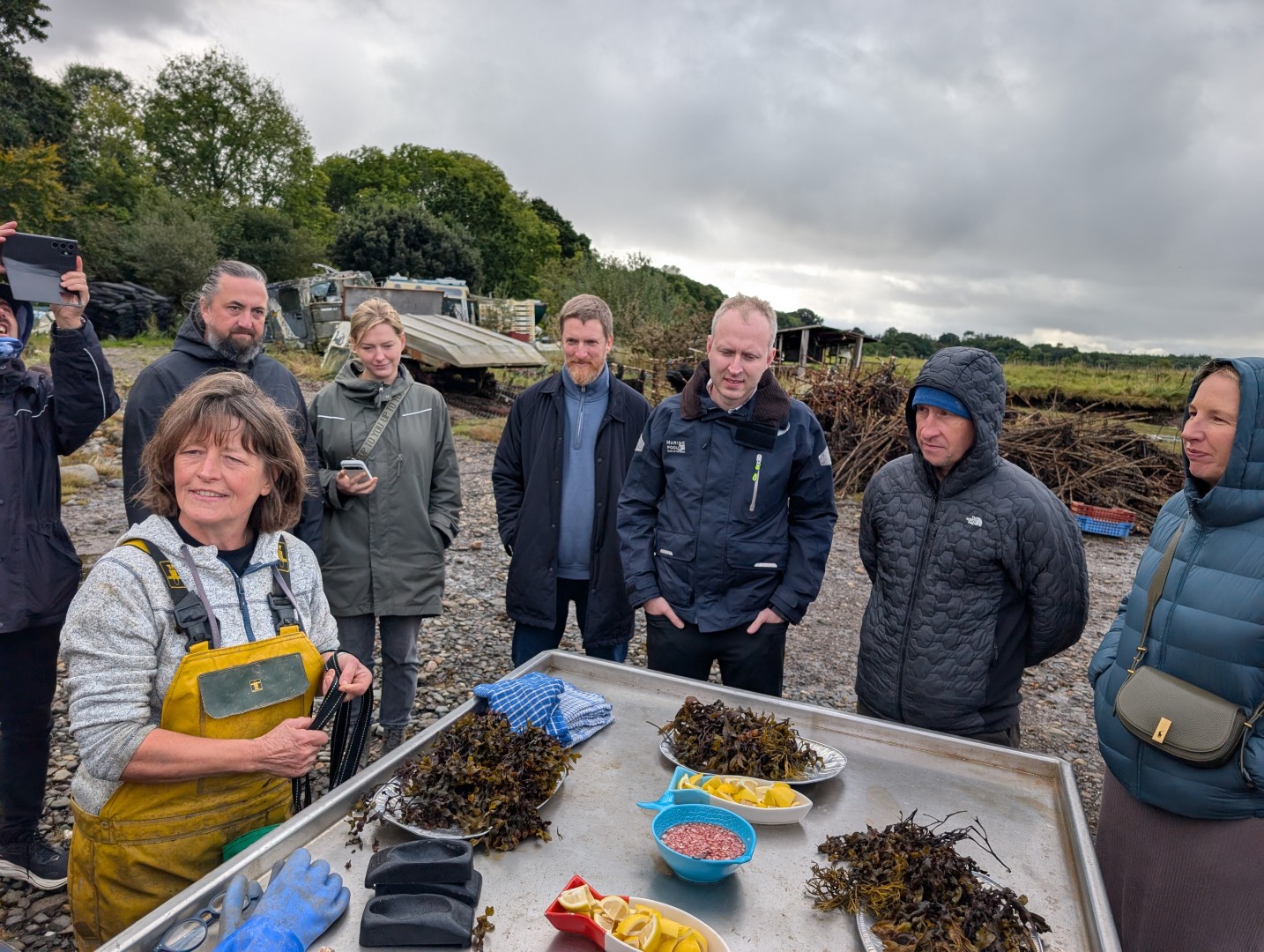
From 14 to 16 September 2026, 23 researchers, entrepreneurs and representatives of development organisations from Estonia and Latvia took part in a MarTe study visit to Scotland, organised by Saarte Koostöökogu. The programme included oyster and seaweed farms, marine research laboratories, businesses and innovation centres.
A major investment before the first harvest or a committed buyer
“What stayed with me most was how openly the Scots acknowledged that getting started with seaweed farming is difficult for them too. The initial investment is substantial, and selling raw biomass alone does not make a business model. Income comes from adding value,” said Urmet.
Farmed seaweed production remains small in Scotland. According to Seaweed Scotland’s director Sarah Evans, the spring harvest arrives within a short period and must be processed or preserved quickly. Equipment, labour, permits, and quality and safety testing all cost money before the first sales come in. This creates a catch-22. A larger buyer needs sufficient production volumes, but a grower needs a committed buyer before expanding.
Urmet said the visit reinforced Planeet Ruhnu’s plans to offer its first seaweed products directly to restaurants and begin fermentation trials this autumn. His wife leads the venture, and he is also involved. Processing, preservation and finding buyers need to be considered from the outset.
There was a familiar idea at the family-run Caledonian Oyster Company too. Customers take oysters from a self-service honesty box and leave their payment. Planeet Ruhnu has already used the same trust-based approach this year and plans to develop it further.
Urmet also highlighted Seaweed Scotland’s Code of Good Practice, which covers seaweed farming from seed material to initial processing. He believes a similar agreement in Estonia would help build trust in the emerging sector among buyers, authorities and local communities.
Ideas need somewhere to be tested
In Lastovskis’s view, Latvia lacks a strong coordination platform that helps entrepreneurs find research partners and somewhere to test their ideas. In Scotland, he saw that cooperation in action.
“What stood out to me most was the development of research infrastructure and the level of collaboration between different industry stakeholders,” he said.
Existing laboratories and equipment allow students, researchers and entrepreneurs to test ideas before investing in their own production facilities. Lastovskis sees a similar role for a blue economy cluster or centre in Latvia, helping people access research partners, laboratory equipment and designated marine testing areas.
Seaweed and shellfish farming are not yet established activities in Latvia. However, the first farms could already provide knowledge about local marine conditions and biomass for developing new products. Lastovskis noted that Scotland’s emerging farms are already serving this purpose.
“Although the Baltic Sea has its own unique environmental conditions, many of the approaches and technologies we saw in Scotland, particularly those related to marine resource processing and the development of new products, could be adapted to the Latvian context,” he said.
From windowsill experiments to a company employing 60 people
Edinburgh-based MiAlgae grows omega-3-rich microalgae using a nutrient-rich liquid co-product from whisky production, turning them into a feed ingredient. The company began with Douglas Martin’s experiments in bottles on a windowsill while he was a student. Today, it employs 60 people and demonstrates how one industry’s co-product can become another’s raw material.
Urmet immediately connected this approach with opportunities on Ruhnu.
“They grow microalgae using whisky industry waste. On Ruhnu, co-products from fish cleaning, seaweed drying and café kitchens are waiting for the same kind of attention,” he said.
The MiAlgae visit also showed why the testing facilities highlighted by Lastovskis matter. Microalgae grow in liquid and must be separated from it to produce a feed ingredient. At Heriot-Watt University’s FlexBIO pilot facility, the company had tested this step by processing around 150 litres of fermentation broth using a centrifuge. This allowed it to assess the separation method at a larger scale before investing in its own production equipment.
Urmet believes that development opportunities in Estonia depend too heavily on individual projects. Businesses also need support between one project ending and the next beginning. In Latvia, Lastovskis stresses the need for stronger cooperation and a clear long-term direction.
Explore the places and organisations visited in Scotland
The study visit brought participants into contact with growers, researchers and organisations supporting business development. Explore their work below.
Farms and businesses
Marine research and aquaculture
Business support and testing facilities



Funded by the European Union under Grant Agreement ID 101186498. Views and opinions expressed are however those of the author(s) only and do not necessarily reflect those of the European Union. Neither the European Union nor the granting authority can be held responsible for them.