From oysters to microalgae: how do marine ideas become businesses in Scotland?
Seaweed grows in the sea. But can it grow into a business? How does a device developed for scientific research become a commercial product? And can a whisky industry by-product become a new raw material?
These were the questions explored by 23 participants from Estonia and Latvia during a study visit to Scotland on 14–16 September. Organised by Saarte Koostöökogu as part of the MarTe project, the visit brought together marine researchers, entrepreneurs and representatives of organisations working to develop the blue economy. Visits to oyster and seaweed farms, marine research laboratories and innovation centres showed how cultivation and experiments can lead to products and viable businesses.
Scotland’s marine conditions differ from those of the Baltic Sea. The aim was therefore to find ideas to test and develop in Estonia and Latvia, rather than ready-made solutions.
Oysters: one product, two different business models
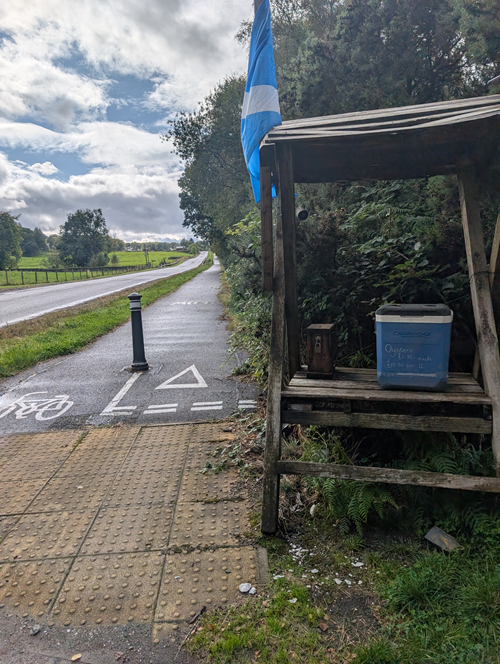
Beside the road leading to the Caledonian Oyster Company’s farm stood a cooler filled with oysters. Next to it were a price list written in chalk and an honesty box. Passers-by could take a single oyster or a dozen and leave their payment in the box. Judith Vajk and her son Angus Vajk began selling oysters this way during the COVID-19 pandemic, when restaurant orders declined.
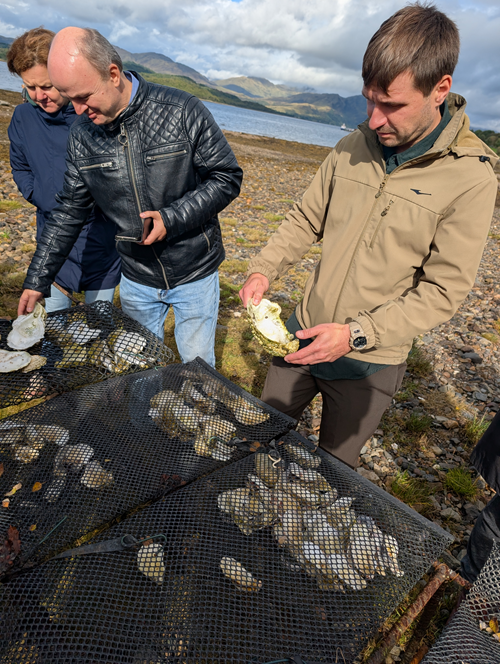
The farm buys young oysters and grows them in mesh bags attached to racks in shallow water. They generally take four years to reach market size. During that time, the bags need regular turning and the oysters need shaking to stop them from attaching to one another. The oysters are also periodically removed and sorted by size to give them enough room to grow. Turning the bags helps prevent seaweed and barnacles from covering them.
Reaching market size does not always mean an oyster is sold straight away. If there is no demand for its size, it stays in the sea and continues to grow. Restaurants generally prefer smaller oysters, while larger ones also find buyers in Asia.
Much of the work is done by hand. According to Angus, the farm has yet to find a good automated solution for turning the bags and shaking the oysters. What they miss most, however, is a machine for moving heavy bags and harvested oysters. They previously used a tracked vehicle to reach the racks at low tide, but it broke down.
Before sale, the oysters undergo a purification cycle lasting around 48 hours. As they filter clean seawater, they expel some of the microorganisms accumulated inside them. The water circulating through the tank also passes through a UV treatment unit.
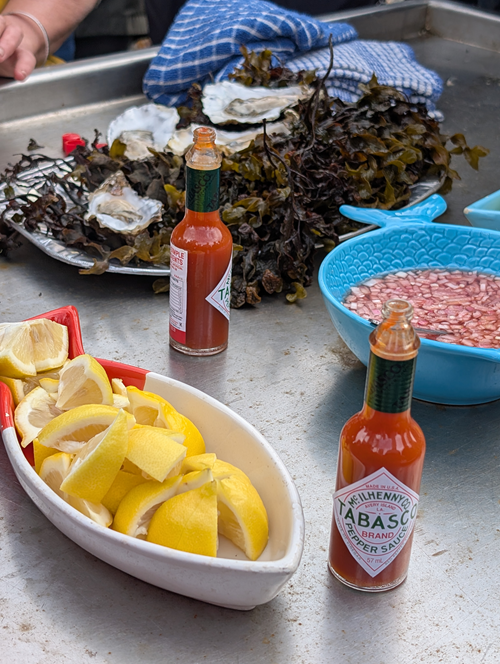
At the farm, oysters were served with lemon, with Tabasco or an onion dressing as optional additions. Reactions varied: one oyster was enough for some participants, while others described it as one of their most memorable tasting experiences in recent years.
The farm is a family business employing four people.
Loch Fyne Oysters offered a different sense of scale. Founded as an oyster farm in 1978, the company built its reputation on oysters. Today, according to the host, its largest source of revenue is buying salmon, hot- and cold-smoking it, and selling the finished products. Oysters remain an important part of the brand. Loch Fyne grows its own, supplies young oysters to other growers, and purifies and sells both its own harvest and oysters sourced elsewhere. Participants sampled several of its products at the company’s restaurant.
Experienced staff are one of Loch Fyne Oysters’ strengths, with many having worked there for years. Recruiting new people is harder. The company invests in retaining its staff, but the host explained that some overseas workers left after Brexit. During the COVID-19 pandemic, others returned to their families and never came back. The remote location adds another constraint: taking a job there often also means choosing to live in rural Scotland.
Turning marine data into decisions and research into products
Measurements help growers act at the right time
Based in Oban, the Scottish Association for Marine Science (SAMS) conducts marine research and provides monitoring and advisory services to businesses. Its models help growers make practical decisions about where to establish a farm, when to harvest and when to put young seaweed out to sea.
NewDEPOMOD, for example, predicts where particles from a salmon farm will settle on the seabed and whether a proposed farm could place excessive pressure on it. HABreports provides warnings about harmful algal blooms and toxins that can accumulate in shellfish.
SAMS researcher Dr Reina Veenhof described a case in which heavy rainfall changed the timing of seaweed deployment. Rainwater had formed a layer of less saline water near the surface of a sheltered bay, creating conditions to which young seaweed is sensitive. SAMS monitored conditions after the storm and delayed deployment by about a week. A nearby farm put its seaweed out earlier and lost its crop.
An ice research instrument becomes a commercial product
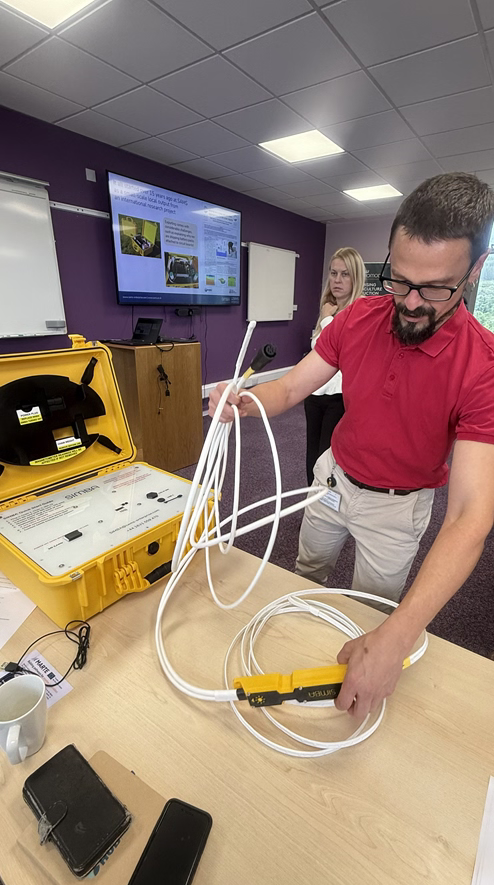
In Canada, an ice jam on the Churchill River caused flooding in 2017, forcing a nearby community to evacuate. SIMBA instruments were subsequently installed on the river to monitor ice thickness. They transmit data via mobile networks or satellite, allowing measurements to be accessed on a computer without someone having to go onto the ice each time.
SIMBA was originally developed at SAMS to study the melting of polar sea ice. Sensors installed in the ice measure temperature at different depths, helping researchers track changes in the boundaries between snow, ice and water. Alongside scientific research, the device is now used to monitor conditions on ice roads and around hydroelectric power stations.
SAMS Enterprise manufactures and sells the instruments. According to its Business Development Manager, Daniel Carcajona, around 30–40 SIMBA units are sold each year, at a price of approximately £7,000 each, depending on the configuration. The instruments are assembled, configured and calibrated on site. A few are kept in stock, but most are made to order.
Can seaweed become a viable business?
The SAMS laboratory offered a close look at the first stages of seaweed cultivation. Young seaweed is grown from seed material on fine twine before being transferred to the sea in autumn. Nutrients are more plentiful in winter; in spring, phytoplankton begins competing for them. Harvesting usually takes place in spring, before other marine organisms have had time to colonise the seaweed extensively.
Seaweed Scotland’s Sarah Evans explained that Scotland also harvests wild seaweed, which is used to make products such as agricultural biostimulants. By comparison, the volume of seaweed cultivated on lines at sea remains small.
Increasing production takes more than growing seaweed successfully. The spring harvest must be processed or preserved quickly, requiring equipment and labour. Licensing costs also apply, along with quality and safety testing, depending on the intended product. Evans explained that the combined costs can exceed what buyers are willing to pay.
Seaweed can be cultivated at sea, yet Scotland is still working out how to turn that capability into a consistently viable business.

Growing omega-3 from a whisky industry by-product
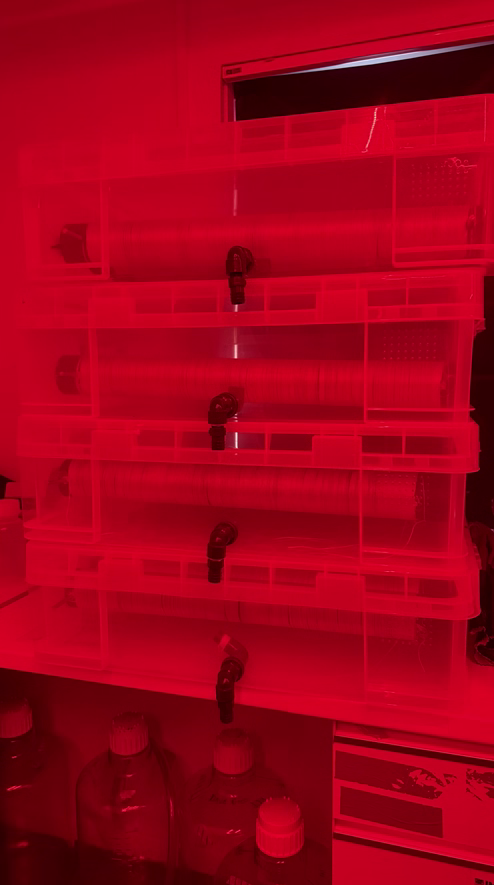
Edinburgh-based MiAlgae connects two seemingly distant industries: whisky production and fish feed. Fish farms need feed rich in omega-3 fatty acids. The fish oil used in these feeds is usually obtained from wild-caught fish, which in turn acquire omega-3 through their diet. MiAlgae goes directly to the original source, growing omega-3-rich microalgae and turning them into an ingredient for fish feed.
To grow the microalgae, MiAlgae uses pot ale, a nutrient-rich liquid left over from whisky production. This gives an industrial by-product a new use while providing an alternative source of omega-3 to fish oil.
Douglas Martin founded MiAlgae in 2016 while studying at the University of Edinburgh. Early experiments in bottles developed into small-scale trial production. Now, almost ten years later, the company is building its first large-scale production facility. The host did not disclose which microalga is used in production, as this is a trade secret. Meanwhile, laboratory work continues on other strains and on how by-products from different distilleries affect growth and omega-3 content.
To increase output, MiAlgae plans to use several identical tanks side by side, rather than build ever larger ones. As the host explained, transport limits the size of each tank. A suitably sized unit can be moved to another production site, allowing facilities to be established close to distilleries and additional tanks to be installed as demand grows.
A promising solution needs somewhere to be tested
A marine business may need workspace, a scientist to help investigate a problem, or equipment to test a laboratory process at a larger scale. In Scotland, different organisations provide support at each of these stages.
At the marine science park developed by Highlands and Islands Enterprise (HIE), a small team can move into suitable office or laboratory space without first having to build its own facilities. During the visit, the new Camas House was still awaiting its first tenants, while marine businesses were already operating in neighbouring Malin House.
One company that grew out of the park is Tritonia Scientific. According to the HIE host, it began with one person and now employs around twenty. The company uses robots to investigate underwater structures and creates three-dimensional models from their camera images. The host also described a business that operated in the park for 15 years and provided employment, but ultimately failed to turn its development work into a viable business.
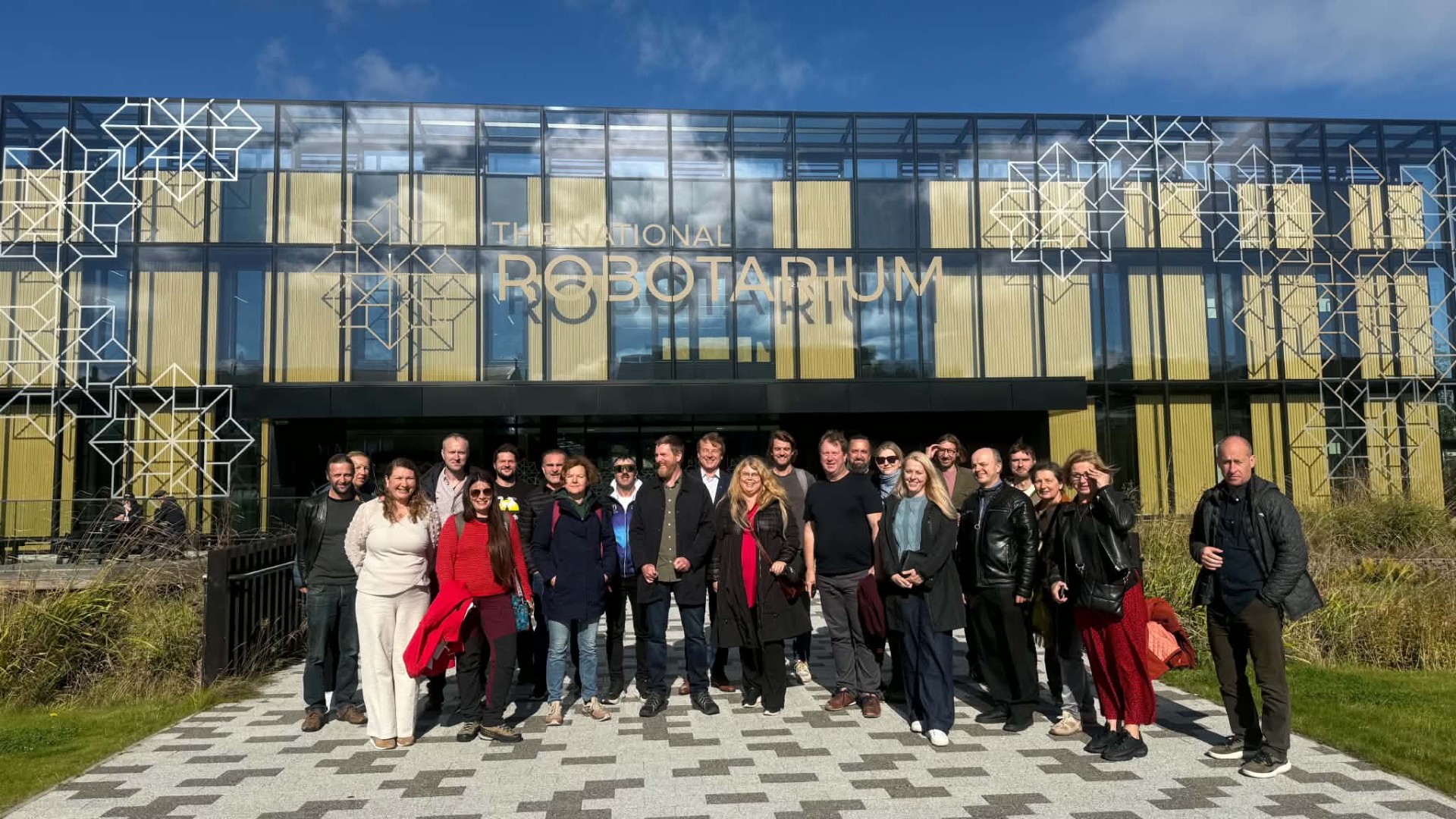
At Heriot-Watt University’s National Robotarium, participants learned about the work of the Sustainable Aquaculture Innovation Cluster (SAIC). The organisation brings together aquaculture businesses, researchers and technology developers to address shared problems and test solutions on working farms. One example involved a device trialled at a Shetland fish farm to monitor potentially harmful plankton around the clock. The SAIC hosts also expressed an interest in exploring collaboration with the Estonian and Latvian participants.
On the same university campus, IBioIC’s FlexBIO facilities offer a way to take the next step: testing whether a biological process that works in a small laboratory will also work at a larger scale. Larger tanks change conditions such as mixing, oxygen availability and temperature control. After cultivation, the microorganisms or the desired substance must also be separated from the liquid.
MiAlgae, whose operations the group had visited earlier, had used FlexBIO to test this final step. The company trialled the separation of microalgae from approximately 150 litres of cultivation broth. The centrifuge trial provided data to help plan the same process at a larger production scale.
Ideas need people to take them forward
The four-person oyster farm is a family business, Loch Fyne Oysters struggles to recruit new staff, and MiAlgae grew out of one student’s experiments. Technology, knowledge and access to testing facilities create opportunities, but much depends on the people who can put them to use and develop an idea further.
Alongside new equipment and cultivation methods, participants’ feedback highlighted the connections made during the visit: people they could continue working with after returning home.
Explore the organisations featured in this article
Businesses and producers
Marine research and industry networks
Business support and testing facilities



Funded by the European Union under Grant Agreement ID 101186498. Views and opinions expressed are however those of the author(s) only and do not necessarily reflect those of the European Union. Neither the European Union nor the granting authority can be held responsible for them.