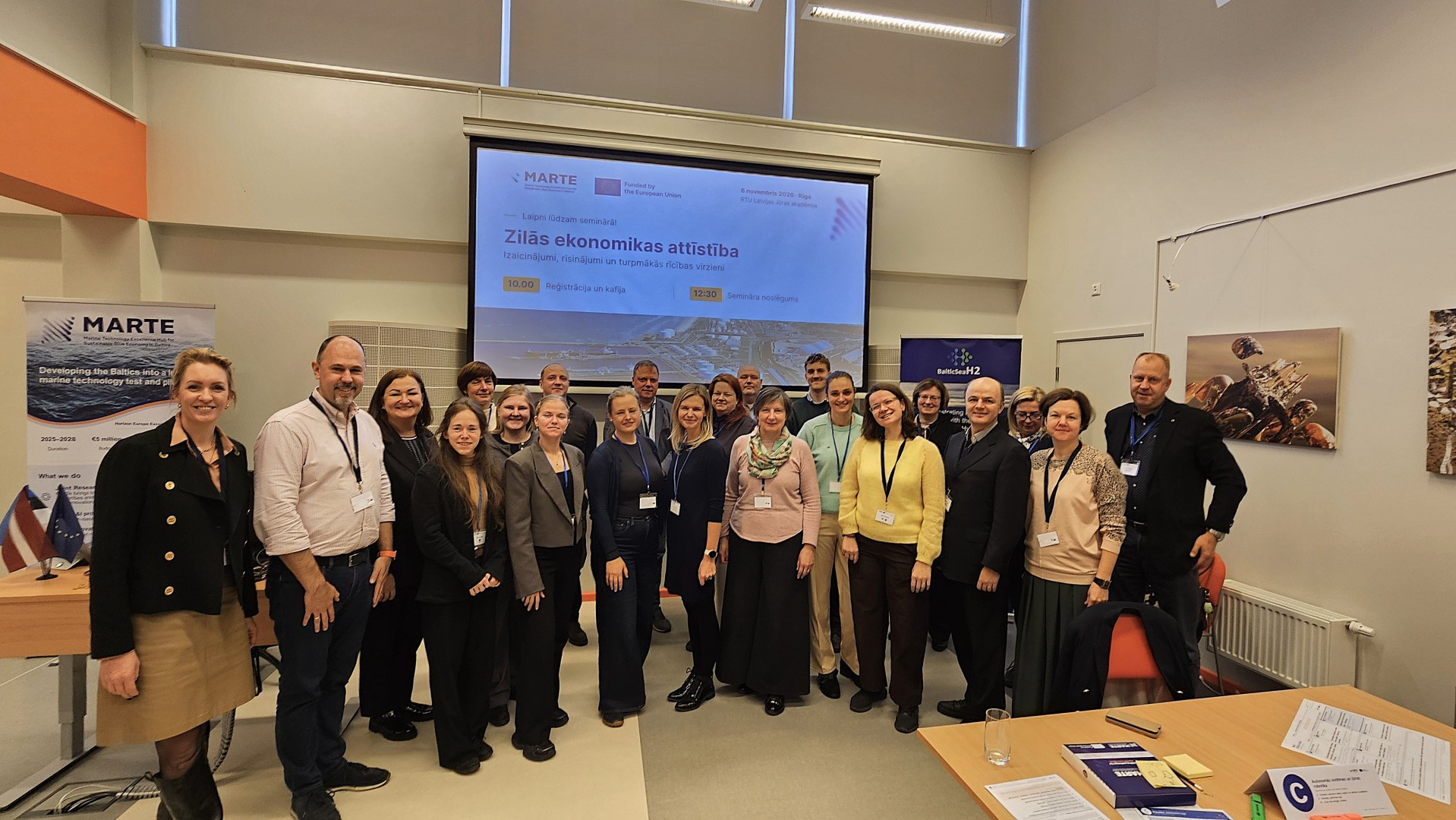
From research to practical solutions: Latvia discusses the future of blue economy innovation
On 5–6 November 2026, the MarTe Latvian Community of Practice seminar, “Blue Economy Development: Challenges, Solutions and Future Directions”, took place at Riga Technical University (RTU), Latvian Maritime Academy.
The two-day event brought together maritime businesses, port and industry representatives, researchers, university lecturers, policymakers, public authorities, innovation support organisations and NGOs.
The seminar focused on opportunities for developing Latvia's blue economy, barriers to marine technology innovation and the next steps needed to turn research and technological developments into practical solutions.
Participants were introduced to the MarTe Research and Innovation Strategy and discussed cooperation between research and industry, access to technology testing infrastructure, investment needs and the challenges of bringing new technologies to market.
From research to the first customer
Latvia has the research expertise, engineering companies and maritime infrastructure to develop new technologies. The challenge is connecting these strengths, improving access to testing facilities and helping promising solutions reach their first users and customers.
From research to market: addressing the barriers to innovation
The assessment of Latvia's marine technology innovation ecosystem has identified several challenges that make it difficult to bring new technologies into practical use.
Latvia has research institutions, engineering companies, ports and maritime specialists with relevant expertise. However, stronger cooperation, better coordinated access to testing infrastructure and support for technology development from prototype to market are still needed.
These challenges were reflected throughout the seminar's presentations and discussions.
Astrīda Rijkure from Kurzeme Planning Region introduced the MarTe Research and Innovation Strategy, while Anda Ikauniece, leading researcher at the Latvian Institute of Aquatic Ecology, addressed technology testing opportunities, innovation infrastructure and the development roadmap.
Ieva Mežaka from the Baltic Institute for Natural Capital (B-Nature) explored cooperation challenges within the marine innovation ecosystem and opportunities to build stronger connections between researchers, businesses, public authorities and other stakeholders.
Kaspars Liepiņš from the Freeport of Ventspils Authority focused on the relationship between human capital, knowledge and market needs. He particularly highlighted the critical stage when a technology developed through research needs to find its first user and customer.
On the second day, Dagnija Vecstaudža from RTU presented opportunities for commercialising research results. Līga Ratniece-Kadeģe from the Liepāja Special Economic Zone Authority shared insights from the MarTe study visit to Scotland, highlighting the importance of cooperation between research infrastructure and businesses.
Āris Brencis, Head of NGL Ventures in Latvia, discussed business modelling and the validation of assumptions, while Kaspars Liepiņš led a workshop on business models for marine technologies.
Marine technologies and innovation facilities in practice
Maija Viška, a researcher at the Latvian Institute of Aquatic Ecology, introduced the work of the MUNIMAP project, focusing on the risks associated with munitions dumped in the Baltic Sea and the importance of assessing these risks using scientific data.
Alongside the presentations, participants visited facilities at RTU Latvian Maritime Academy, where they explored a ship engine room simulator and maritime communication equipment.
They also learned about the technological capabilities of RTU SkyLab and the Innovation Laboratory.
At Ķīpsalas 6A, participants had the opportunity to see an unmanned surface vessel operated by LVR Flote for hydrographic surveys, as well as a boat built by the Ventspils-based company Aspired.
These practical examples provided insights into marine technologies, their applications and the capabilities of Latvian companies working in maritime innovation.
Bringing different perspectives together
An important part of the seminar was the joint work in expert groups.
The discussions brought together professionals from different fields, each contributing their knowledge and practical experience. Participants included people who develop and use technologies, manage businesses, study the marine environment, plan investments, shape policies and make decisions affecting the sector's development.
Together, they examined priorities for blue economy development and worked on innovation business models, focusing on specific industry needs, potential technology users and the conditions required for new solutions to be adopted.
The different professional perspectives helped build a more comprehensive understanding of Latvia's maritime sector, its development opportunities and the steps needed to strengthen the marine innovation ecosystem.
This work also continued the development of the MarTe Latvian Community of Practice, which began at the previous seminar in Liepāja.
Next steps for marine innovation
The discussions in Riga highlighted the importance of turning research results and technological expertise into solutions that can be tested, developed and used in practice.
Upcoming opportunity
MarTe BlueInnovation Open Call
To support further marine technology development, MarTe is preparing the BlueInnovation Open Call, planned for early 2027.
€360,000 total funding
At least six pilot projects planned, with up to €60,000 available per project.
The support will focus on prototype development, testing and further technology advancement. Selected projects will also receive individual mentoring.
The planned priority areas include offshore renewable energy, smart ships and ports, sustainable marine resource use and marine ecosystem protection.
Detailed eligibility criteria and application procedures are expected to be published in January 2027.
The Latvian Community of Practice seminar was another step in MarTe's efforts to strengthen cooperation, develop technology testing opportunities and bring research and industry closer together.
Thank you to all participants for their professional contributions, open discussions and willingness to share their knowledge and experience. Special thanks to the MarTe partners, speakers and RTU Latvian Maritime Academy for hosting the event and providing opportunities to explore technologies in practice.
The seminar was organised as part of MarTe – Marine Technology Excellence Hub for Sustainable Blue Economy, funded by the European Union's Horizon Europe programme.
You can download the seminar presentations below. All presentations are in Latvian.



Funded by the European Union under Grant Agreement ID 101186498. Views and opinions expressed are however those of the author(s) only and do not necessarily reflect those of the European Union. Neither the European Union nor the granting authority can be held responsible for them.