“We do not have large investment volumes, and we do not do mass production in the Baltics, but we still have an opportunity.”
Tiina-Maria Araja, presenting the MarTe research and innovation strategy
Araja explained that Estonia and Latvia's opportunity lies primarily in developing sustainable, smaller-scale marine technologies adapted to local conditions.
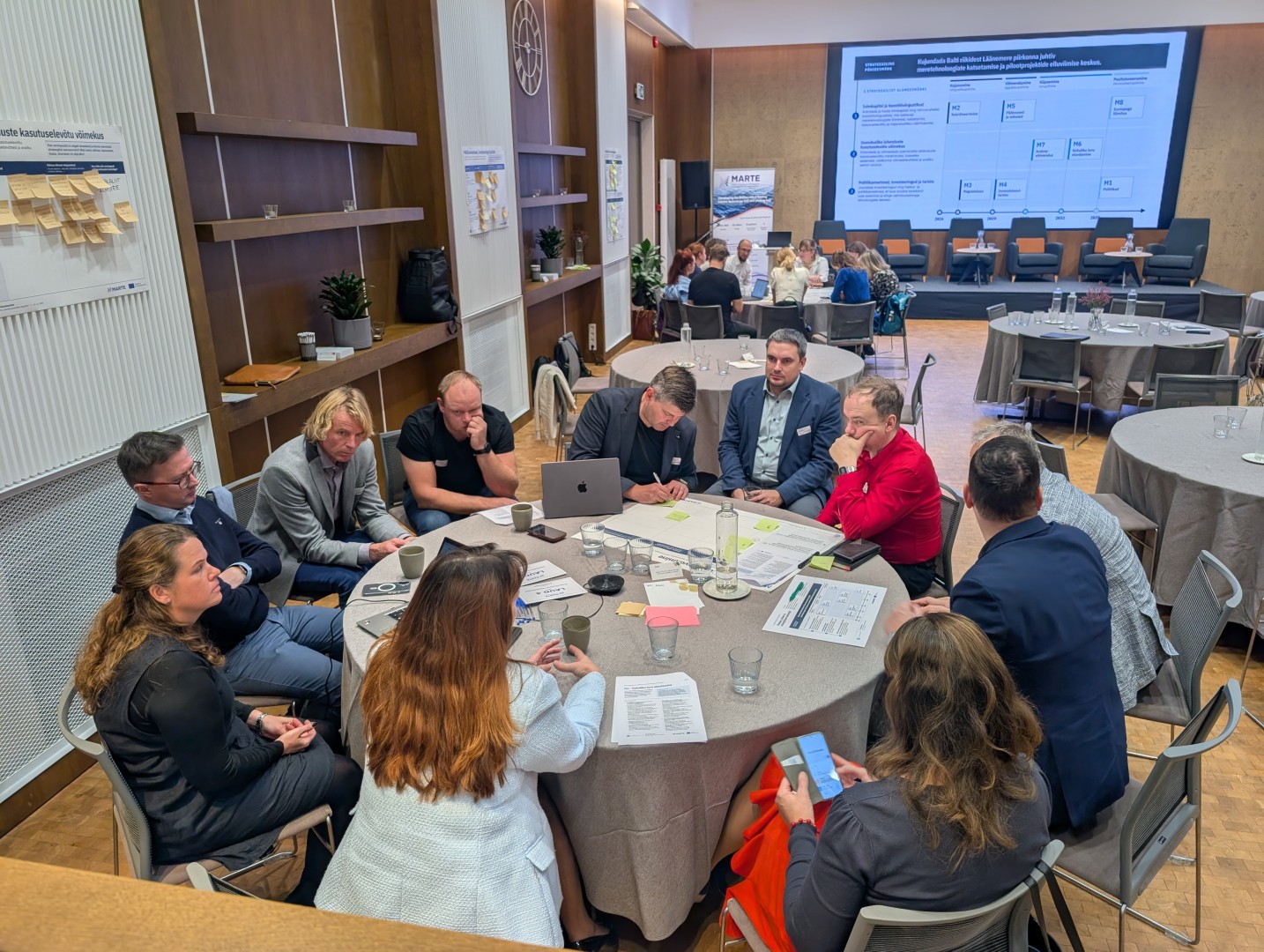
Researchers, businesses, public authorities and coastal community representatives reviewed the draft joint research and innovation strategy for Estonia and Latvia and proposed ways to strengthen it.
What emerged from the discussions in Laulasmaa?
01 / Make marine testing easier
A marine test area is more than a location: it needs infrastructure, data, permits and coordination. Temporary testing also calls for a more flexible legal framework.
02 / Help new technologies find their first users
Ports and public-sector organisations can become early customers. Innovation procurement can help companies demonstrate solutions in practice and gain initial sales experience.
03 / Make marine data easier to find and use
Map existing datasets, assess their quality and improve the use of common data formats.
04 / Take a broader view of port development
Bring existing studies together, assess future needs and explore funding models that reflect ports' wider economic and community value.
05 / Strengthen links between research and business
Identify skills needs, connect research results with education and improve access to experts and international markets.
06 / Give joint priorities clear ownership
Turn cooperation between Estonia and Latvia into concrete actions, named responsibilities and measurable results.
A marine test area is more than a dot on a map
Imagine a company that has developed a new autonomous marine device. It works well in the laboratory, but before it can be brought to market, the developer needs to know whether it can withstand waves, ice and changing weather conditions. Where can it be tested? Which permits are required, and who can help organise the trial?
Professor Kristjan Tabri of Tallinn University of Technology (TalTech) stressed that a marine test area is not simply a location but a complete service. Developers need to know where and under what conditions they can test their technology, which data and infrastructure are available, and who is responsible for coordinating the tests.
As part of MarTe, the testing needs of 20 technologies have been analysed, leading to the description of eight potential types of test area. Not every technology needs to go straight to sea: early tests may be carried out in a digital environment or a test basin, while other solutions need a port, offshore waters or specific marine conditions. A decision-support tool is also being developed to help match technologies with suitable testing environments.
A glimpse into the future – testing in a virtual sea
Is the entire Baltic Sea suitable for mussel farming? Not at all. Mussel growth depends on salinity, temperature and the availability of microalgae as food. The selection of a farming site also needs to account for waves, currents and ice, which can damage equipment.
Professor Jonne Kotta of the University of Tartu introduced two digital tools that help answer these questions. An AI-based research adviser searches scientific literature and provides answers with references. A map-based application then helps identify marine areas that meet the required environmental conditions.
Alongside long-term datasets, short-term forecasts can be used. For example, the application can warn fish farmers up to two days ahead of a sudden drop in water temperature. Such changes can threaten fish survival, while advance warning gives farmers time to take protective measures, such as adapting feeding or, if necessary, harvest plans.
Reliable forecasts begin with actual measurements. TalTech professor Taavi Liblik presented Merehunt, an initiative to establish a network of smart buoys in Estonian marine areas. Automated instruments can gather data continuously, including when research vessels are not at sea. Combined with satellite and vessel-based observations, these measurements can provide a more complete picture of changes in the marine environment.
TalTech professor Rivo Uiboupin demonstrated how observational data can be used to create digital twins of the marine environment. These combine real-world measurements with computer models to forecast changes and explore different future scenarios. They can, for instance, simulate how the construction of all planned Baltic Sea wind farms might affect currents or estimate where pollution could spread. By combining weather forecasts with observations, a digital twin can also assess whether strong winds could cause flooding in a port or lower water levels enough to prevent ships from moving.
Marine data are being collected in increasing volumes, yet they are often difficult to find and combine. Uiboupin noted that it can sometimes be easier to obtain data about Estonian marine areas through international portals than from local institutions and research projects. Further progress therefore depends not only on new sensors and more powerful models, but also on making better use of the information already collected.
A two-month test may require the same permit as a permanent structure
In Estonia, testing temporary marine technology can require essentially the same permitting procedure as building a structure intended to remain in place for decades.
Siim Vahtrus, an attorney-at-law at Ellex Raidla, explained that testing prototypes attached to the seabed is particularly difficult. Procedures for obtaining the right to use a marine area and assessing environmental impacts can take years and involve substantial costs. By contrast, temporary testing of vessels generally works relatively well.
Vahtrus proposed framework permits for shared test areas. A test-area operator would obtain the main permits in advance, allowing companies to test technologies within agreed conditions rather than starting the entire permitting process from scratch each time.
Some existing requirements would still need to change. At present, permits for marine construction or environmental activities may be revoked if the planned activity does not begin within a specified time. In a shared test area, permits should remain valid when different companies begin their trials at different times. Repeated environmental impact assessments should also be avoided where the impacts have already been assessed as part of the initial framework permit.
EU law allows certain technology-testing projects lasting up to two years to undergo preliminary screening rather than automatically requiring a full environmental impact assessment. “We do not yet have this option in our national legislation,” Vahtrus explained. A corresponding bill was under consideration in the Estonian Parliament, although screening can still conclude that a full assessment is necessary.
The way fees for using marine areas are calculated also needs reviewing. At present, fees may be charged for the whole permitted area and period even when only part of the area is used or a test lasts for a short time. Vahtrus argued that fees should better reflect the actual scale and duration of testing.
Ports may determine where new marine industries emerge
Without a suitable port, a new marine activity may never begin, or it may move to another country along with jobs and investment. Offshore wind farms, offshore aquaculture and marine technology trials all need ports with appropriate facilities, logistics and energy connections.
“Costs are often in one place and revenues in another.”
Marti Hääl, Alexela
Hääl used this observation to describe a central contradiction in port development. Port owners make substantial investments, but the economic benefits may be realised by businesses elsewhere in the region. Revenue from port fees may not even cover the costs of running the port.
The situation is made more difficult by mutual dependence: companies expect the necessary port facilities to be in place before they begin operations, while ports need confidence that future customers will arrive before investing. Hääl suggested one potential model in which public funding helps build port infrastructure while the port covers its day-to-day operating costs.
Anni Hartikainen of the Estonian Marine Industry Association explained that marine activities can still go ahead without a suitable local port, but the associated jobs and economic value may move abroad. A port study produced under the Interreg Estonia–Latvia project Harbours and PPP indicated that wind farms planned off the western coast of Saaremaa might be serviced from Ventspils in Latvia if no suitable local service port is available. For offshore fish farms planned off the western coast of Hiiumaa, the lack of a nearby port may mean that the projects do not proceed at all.
Hele-Mai Metsal of the Port of Tallinn stressed that ports must anticipate future demand. Planning for a quay at Paldiski South Harbour intended to serve offshore wind projects began as early as 2010. Such investments take years to prepare, even though future customers are not guaranteed. Metsal identified another obstacle: even if a port is ready to serve new industries, insufficient electricity grid capacity can prevent developments from moving ahead. Port facilities and energy connections therefore need to be planned together.
For some ports, however, the issue is not just profitability but the viability of an entire community. Mihkel Urmet of Planeet Ruhnu described Ringsu harbour as the island's “lifeline”, connecting Ruhnu with the outside world. He argued that port development must reflect local needs while opening up opportunities for new activities. Planeet Ruhnu has, for example, begun experimental seaweed farming, which creates new requirements for the use of the harbour.
Urmet also saw potential in cross-border cooperation, naming Roja harbour in Latvia as a possible partner for Ringsu. More broadly, participants discussed developing a complementary Estonian–Latvian port network, rather than expecting every port to make the same investments or provide every service.
Ports and coastal communities panel. From left: moderator Sander Loite, Marti Hääl (Alexela), Hele-Mai Metsal (Port of Tallinn), Anni Hartikainen (Estonian Marine Industry Association) and Mihkel Urmet (Planeet Ruhnu).
Innovation alone is not enough – technologies also need users
Estonia could provide excellent marine testing facilities, but what happens if the solutions developed here never find users? Kristjan Truu, Deputy Secretary General for Maritime and Water Environment at Estonia's Ministry of Climate, stressed that the country should not limit itself to testing new technologies: it should also develop them. Climate and environmental requirements increase demand for new solutions and create opportunities for Estonian companies.
Eduard Koitmaa of the Ministry of Regional Affairs and Agriculture highlighted one practical opportunity. Estonia's fishing fleet is ageing, and its renewal is important for food security. If European funding is used to modernise fishing vessels, Estonian shipbuilders could be ready to supply their own technologies and solutions, helping domestic marine industries benefit from that investment.
Kristel Reim, Head of Knowledge Transfer at the Ministry of Education and Research, explained that research funding is increasingly designed to involve companies from the beginning of the development process. She also noted that existing support opportunities and initiatives do not always reach the people who could benefit from them.
Timing matters for funding as well. Preparations for the EU's next seven-year funding period offer an opportunity to influence future priorities. Martti Kalvik, Head of Strategic Planning at the Ministry of Economic Affairs and Communications, stressed that marine technology firms should also look beyond blue-economy-specific programmes to broader innovation and business support measures. Their needs and proposals must, however, be communicated at the right time.
How can the marine sector make sure its needs and proposals reach policymakers?
“Speak, speak. If you have a concern, speak up, ask questions, speak, speak and keep speaking.”
Lembe Reiman, Ministry of Economic Affairs and Communications
Reiman's point was that decision-makers cannot address problems they have never heard about. She also stressed that marine technology and blue economy development must take into account the needs of people living in coastal communities and on islands.
Policy panel at the MarTe Estonian Vision Seminar. From left: moderator Sander Loite, Martti Kalvik (Ministry of Economic Affairs and Communications), Kristel Reim (Ministry of Education and Research), Kristjan Truu (Ministry of Climate), Lembe Reiman (Ministry of Economic Affairs and Communications) and Eduard Koitmaa (Ministry of Regional Affairs and Agriculture).
An opportunity to test marine technologies is planned for January
Alongside the joint strategy, MarTe is preparing practical support for new marine technologies. The Blue Innovation Open Call is planned for January 2027, with the aim of helping technologies under development reach testing and validation in relevant real-world environments.
The proposed budget is €360,000, with plans to support six pilot projects with grants of up to €60,000 each and offer mentoring to developers.
The call is intended for technologies with a readiness level of at least TRL 3, with the potential to progress towards TRL 6 during the project. In practical terms, this means moving from an initial proof of concept towards demonstrating a technology in a relevant environment.
Areas expected to be covered include offshore renewable energy, smart vessels and ports, aquaculture, sustainable use of marine resources and marine ecosystem protection. The final conditions and timetable will be published on the MarTe website once confirmed.
From shared vision to practical action
The Laulasmaa seminar did not settle every question. It did, however, help clarify which obstacles need to be addressed first and which steps could make the greatest difference to marine technology development in Estonia and Latvia.
About MarTe. MarTe (Marine Technology Excellence Hub for Sustainable Blue Economy) is a Horizon Europe project bringing together 13 partners from Estonia and Latvia to strengthen marine technology research and innovation and support a sustainable blue economy. The project is coordinated by the Environmental Investment Centre.
You can download the seminar presentations below. All presentations are in Estonian.