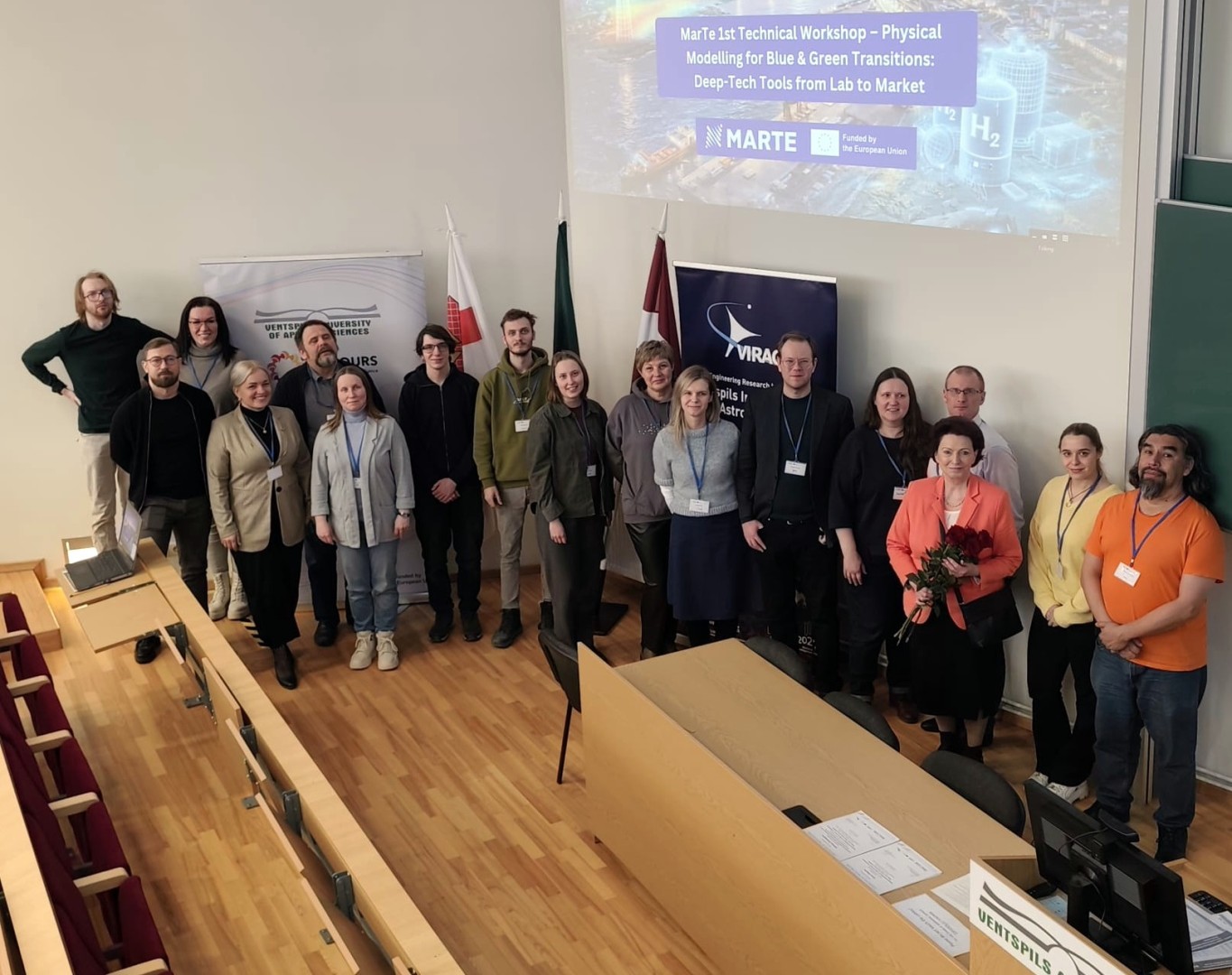
Researchers Demonstrate How Simulation Tools Drive Maritime Innovation at MarTe Technical Workshop
The first MarTe technical workshop, “Physical Modelling for Blue and Green Transitions: Deep-Tech Tools from Lab to Market,” brought together researchers, engineers and industry representatives to examine how advanced simulation tools support maritime innovation in the Baltic Sea region.
The event focused on physical modelling — digital methods that allow engineers to test and optimise ideas virtually before building physical prototypes. Across the presentations, modelling was shown not as a side tool, but as a central part of research, development and technology deployment.
From AI-Assisted Design to Industry-Ready Skills
Digital product development was one of the key themes. Representatives from PLM Group Sverige AB introduced recent developments in SOLIDWORKS, a widely used 3D computer-aided design (CAD) software. They presented newly integrated AI-assisted design functions that help optimise geometry and reduce iteration time in early-stage design.
They also introduced programmes offering free SOLIDWORKS licences. This is significant because commercial licence fees can be high and often represent a barrier for smaller or newly established companies. Providing access to professional design tools lowers entry barriers for prototype development and early innovation.
From the academic perspective, Modris Dobelis (Riga Technical University) showed how SOLIDWORKS is integrated into engineering study programmes. Students build practical modelling skills as part of their coursework and prepare for industry certification during their studies. The session demonstrated how structured hands-on training helps align university education with real industry expectations.
Learning from Structural Simulation
Kristjan Tabri (Tallinn University of Technology) presented a numerical reconstruction and structural assessment of the MS Estonia ferry disaster. Using computational methods such as load simulations and failure analysis, he demonstrated how modelling can be used to analyse structural behaviour under extreme conditions.
Although the case focused on a maritime accident, similar structural simulation methods — including finite element analysis and load modelling — are standard practice in safety-critical sectors such as construction, transport systems, energy infrastructure and industrial equipment design. These methods are widely used internationally to evaluate structural reliability before physical testing.
Environmental Forecasting and Port Operations
Uldis Bethers and Tija Sīle (University of Latvia) presented the HywasPort modelling approach. The system integrates atmospheric and hydrodynamic data to forecast wind, wave and sea conditions, including in locations without direct measurement stations.
Such forecasting supports port operations, maritime logistics and coastal risk management. Comparable atmospheric and hydrodynamic modelling approaches are also widely used in practice in offshore wind farm planning, flood risk assessment and infrastructure design.
Hydrogen Systems and Electromagnetic Modelling
Marina Konuhova (Institute of Solid State Physics, University of Latvia) demonstrated the use of multiphysics simulation in COMSOL Multiphysics. COMSOL allows different physical processes to be modelled together within one system. In this case, the focus was on liquid-hydrogen systems, where thermodynamic, fluid dynamic and mechanical processes interact simultaneously. The modelling supports optimisation of compression processes and helps improve safety and efficiency at early design stages.
Vladislavs Bezrukovs (Ventspils University of Applied Sciences) presented electromagnetic simulations in EMWorks for analysing field distribution, induced currents and performance constraints in linear generator systems. Similar electromagnetic modelling tools are routinely used in the design of wind turbine generators, electric motors and power electronics to optimise performance and reduce energy losses before building prototypes.
Andrejs Zvaigzne (Riga Technical University) presented ongoing development work on zero-emission coastal fishing vessels powered by hydrogen fuel cells. The focus was on the current development phase rather than a fully implemented solution. Key challenges discussed included system integration, infrastructure readiness and compliance with safety regulations, all of which must be addressed before wider deployment in the Baltic Sea region.
Materials Performance and Market Uptake
Andrejs Krauklis (Latvia University of Life Sciences and Technologies) discussed modelling approaches for hydrothermal ageing and degradation of polymers, such as plastics and composite materials. The research examines how these materials weaken over time when exposed to heat and moisture. Understanding long-term material behaviour is important for ensuring structural reliability and assessing environmental risks linked to material degradation.
The workshop concluded with the “Spectromarine” case study, presented by Aleksejs Zolotarjovs (Institute of Solid State Physics, University of Latvia). The case highlighted how a clearly defined market niche and strong market fit can compensate for lower technology readiness levels (TRL) and support successful commercialisation. It demonstrated how laboratory-developed water monitoring technologies can progress toward market application when a clear use case is identified.
Why this Matters
Although the workshop focused on maritime applications, the tools presented — structural simulation, environmental modelling, multiphysics analysis and electromagnetic modelling — are widely used across engineering and energy sectors internationally. Digital simulation reduces development risks, shortens testing cycles and improves design decisions by enabling virtual analysis before physical deployment.
The workshop gathered more than 50 participants onsite and online, demonstrating strong regional interest in science-based, modelling-driven innovation in Estonia and Latvia.
If you would like to learn more about upcoming MarTe seminars, technical workshops and collaboration opportunities, we invite you to join our mailing list and stay connected with the MarTe community.



Funded by the European Union under Grant Agreement ID 101186498. Views and opinions expressed are however those of the author(s) only and do not necessarily reflect those of the European Union. Neither the European Union nor the granting authority can be held responsible for them.