MarTe Partners Contribute to High-Level Conference on Sustainable Baltic Sea at Latvian Parliament
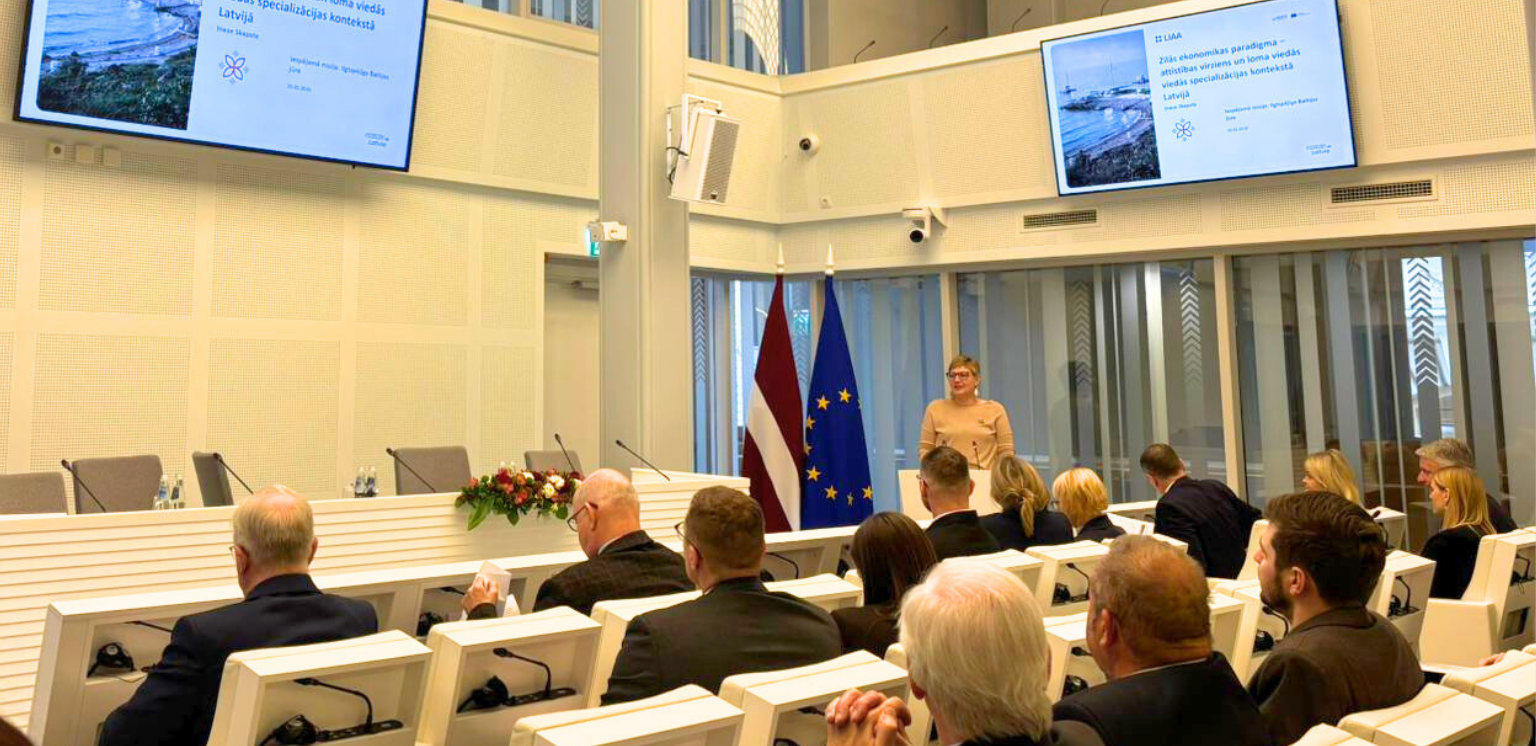
On 20 February 2026, the conference "Possible Mission: A Sustainable Baltic Sea" took place at the Latvian Parliament (Saeima) in Riga. One of the MarTe consortium partners, the World Wide Fund for Nature (WWF) Latvia, was a co-organiser of the event. It brought together policymakers, scientists, businesses and civil society representatives to discuss Baltic Sea environmental protection, sustainable governance and the development potential of the blue economy. At the conference, two other MarTe consortium partners delivered presentations: the Latvian Investment and Development Agency (LIAA) and Kurzeme Planning Region (KPR).
WWF Latvia was represented by Magda Jentgena, Head of the Baltic Sea and Freshwater Programme. In her address, she emphasized that many residents are not fully aware of the current condition of the Baltic Sea, as its environmental state is not visible from the shore. Although the Baltic Sea is the youngest sea in the world, it has also been described as one of the most polluted. “We are not talking about what will happen, but about what is already happening – and it is already serious,” she stressed. According to Jentgena, the Baltic Sea faces multiple pressures, including eutrophication, biodiversity loss, declining fish stocks, climate change impacts and pollution. She noted that while regional cooperation has improved and overall pollution shows a decreasing trend, the Baltic Sea’s unique characteristics – particularly its slow water exchange – mean that positive changes take a long time to become visible in monitoring data. At the same time, short-term economic interests often continue to take precedence over scientific recommendations, creating long-term environmental risks.
LIAA representative Inese Skapste delivered a presentation titled "The Blue Economy Paradigm – a Development Direction and Its Role in the Smart Specialization Context in Latvia". In her speech, she emphasized that the blue economy is a knowledge-intensive marine ecosystem where economic development is driven by innovation, technology and cross-sectoral cooperation, rather than merely by the extraction and use of marine resources.
Her presentation highlighted the shift from "Blue Growth" to a "Sustainable Blue Economy", stressing the need to balance economic, environmental and social dimensions and to integrate these principles into the implementation of Latvia's Smart Specialization Strategy (RIS3). She illustrated how economic theories and European Union policy instruments – including RIS3, the Interreg Baltic Sea Program, the EU Strategy for the Baltic Sea Region (EUSBSR) and Horizon Europe initiatives – are being translated into practical solutions in the Baltic Sea region, such as offshore wind parks, blue biotechnology, digital marine "twins" – virtual models of marine environments, infrastructure or systems that allow real-time monitoring, simulation and testing – and cross-border pilot projects.
In conclusion, Inese Skapste underlined that long-term growth depends not only on the volume of investments, but on how strategically they are directed and how effectively societies are able to learn and collaborate. The blue economy in the Baltic Sea was described as an opportunity for Latvia to demonstrate that knowledge, cooperation and sustainability can become a stronger driver of growth than traditional investment alone.
Zane Gusta, representing Kurzeme Planning Region and the MarTe – Marine Technology Excellence Hub for Sustainable Blue Economy in the Baltics project, delivered a presentation titled "Blue Economy in Practice: Cooperation Networks and Capacity Building in the Baltic Sea Region". She focused on how the MarTe project strengthens the blue economy innovation ecosystem across the Baltics by applying a Quintuple Helix approach and supporting cross-sectoral collaboration between policy makers, scientists, businesses, civil society and environmental actors.
In her talk, Zane Gusta highlighted that sustainable blue economy development requires not only technological progress, but also social sustainability – skills, participation, trust, resilience and inclusive governance – so that innovation becomes a real driver of economic growth rather than remaining at the level of concepts. She presented results of a blue economy ecosystem analysis in Latvia, carried out within MarTe using the Customer Master Data Management (CMDM) methodology, showing current fragmentation in cooperation, regulatory and administrative barriers to piloting, and the need to move from isolated initiatives towards integrated, long-term partnerships and scalable innovation models.
The presentation also demonstrated concrete MarTe activities and their expected impact: a joint long-term blue economy development strategy by 2028, policy reviews and recommendations to improve access to marine areas, four research projects in the Baltic Sea region, grants of up to EUR 60,000 and mentoring programs for SMEs, as well as capacity-building actions to strengthen skills and knowledge in the ecosystem. Zane Gusta concluded that the future competitiveness of the blue economy will depend not only on innovation, but on the ability of regions and stakeholders to cooperate, coordinate and actively involve society, turning the Baltic Sea into a space for shared, sustainable growth.
By contributing to this high-level discussion at Latvian Parliament, LIAA and KPR highlighted Latvia's ambition to position the Baltic Sea as a space where knowledge, cooperation and sustainability become key drivers of growth in the blue economy.
The topics discussed at the conference reflect the core focus of the MarTe project – strengthening cooperation between research, policymakers and businesses in Estonia and Latvia, and turning innovative marine technologies into practical solutions across the Baltic Sea region.
Conference presentations are available via the official Saeima website.
Watch the full conference recording (in Latvian):



Funded by the European Union under Grant Agreement ID 101186498. Views and opinions expressed are however those of the author(s) only and do not necessarily reflect those of the European Union. Neither the European Union nor the granting authority can be held responsible for them.